
The importance of tone of voice: A practical guide to sounding like you (everywhere)

Most businesses don’t have a “tone of voice” problem because they’re bad at writing.
They have a recognisability problem; their words don’t sound consistent across the business, from internal emails to customer comms, so the brand never fully sticks.
You can have a great website, polished branding, and decent content, but if your emails, social posts, brochures, PR quotes, and web pages all sound like they came from different companies… people feel it.
And when people feel inconsistency, they hesitate.
That’s why tone of voice matters. It’s one of the fastest ways to build trust, stand out, and make your brand memorable, without spending more on ads.
This guide breaks down what tone of voice is, why it matters (no matter how big you are), and how to define it in a way your team can actually use.
What is the tone of voice?
Your tone of voice is how your brand sounds in words.
Not just what you say, but how you say it.
It includes things like:
the words you choose (simple vs technical, warm vs direct)
your sentence length (punchy vs detailed)
your level of confidence (bold vs cautious)
your personality (friendly, witty, calm, premium, playful, etc.)
how you address people (formal vs conversational)
how you explain things (straight-to-the-point vs story-led)
how you handle emotions (reassuring, encouraging, blunt, empathetic)
your rhythm (fast-moving vs thoughtful)
before and afters showing practical applications of the ToV in practice (ideally in multiple formats, e.g., short form emails, report writing, etc.)
The most important thing to remember is that a tone of voice guide is only good if it's usable by your team.
What tone of voice covers (and what it doesn’t)
Tone of voice usually applies across:
your website copy
PR messaging and quotes
social captions and comments
email campaigns
proposals and decks
paid ads
customer support
internal comms (which is often overlooked but necessary - the TOV should flow through the whole company)
It doesn’t replace your visual brand. It sits next to it and helps inform how it is represented visually.
For example, Liquid Death leads with a disruptive and humorous tone of voice, with visuals that mimic heavy metal album covers and bold in-your-face branding. Featuring dark, bold aesthetics, aligning perfectly with their sarcastic and shocking "murder your thirst" messaging.
Your logo, colours, and design might get attention… but your tone of voice is what makes people feel like they know you.
Why is tone of voice important?
Tone of voice is important because it creates three things every brand needs:
Trust
Consistency builds familiarity. Familiarity builds trust.
If your brand sounds consistent across every touchpoint, people feel safer choosing you.
Clarity
When your tone is defined, your message gets sharper.
You explain things faster. You use fewer filler words. You stop trying to sound like everyone else.
Differentiation
Competitors can copy your offer. They can match your pricing. They can imitate your content.
But they can’t replicate you, and your brand is your superpower.
A clear tone of voice becomes a real differentiator, especially in crowded industries.
The importance of a defined tone of voice (no matter your company size)
Tone of voice isn’t something you “earn” once you get big.
It’s something you define early so you can grow without losing what makes you you.
If you’re a small business…
A consistent tone:
makes you look more established
helps you stand out against bigger brands
builds a recognisable personality that people remember
makes content creation easier (less second-guessing)
Small businesses often have the advantage here: you’re closer to your customers, and you’ve got a more human story.
If you’re a growing team…
A defined tone:
keeps content consistent as you hire, outsource, and scale
speeds up approvals (less “this doesn’t feel right” feedback)
creates a shared standard for writing and messaging
stops your brand from sounding like five different writers
If you’re a bigger company…
Tone of voice becomes brand protection. It:
aligns marketing, sales, and support
reduces miscommunication
improves customer experience
prevents “corporate fog” where everything becomes vague, padded, and bland
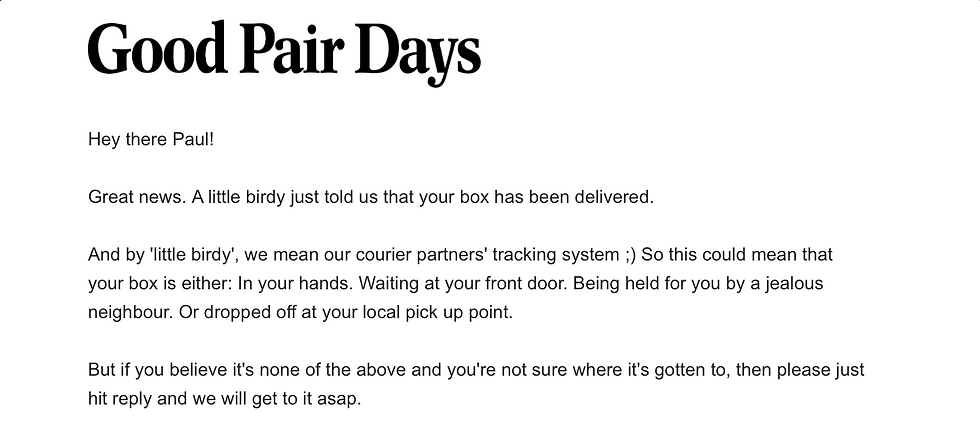
No matter your size, tone of voice helps you sound confident, consistent, and memorable. An amazing example of this comes from Good Pair Days, which offers a wine subscription service. From how they describe the wine on their product page, to being updated on how your delivery is going, you can tell it's their tone of voice, through and through, and it makes you feel more connected and cared for - like a personal touch.
A practical guide to defining your tone of voice (so your team can use it)
This is the part most tone-of-voice docs get wrong. They become a PDF that lives in a folder and never gets used.
A usable tone of voice guide has three things:
clear principles
real examples
simple rules that work in daily writing
Here’s a step-by-step framework that actually sticks.
Step 1: Start with your brand personality (3–5 traits)
Pick 3–5 traits that describe how you want to come across.
Not aspirational fluff, real, usable traits.
Examples:
Warm
Direct
Confident
Helpful
Calm
Playful
Premium
Bold
Straight-talking
Practical
If you can’t explain a trait in a sentence, it’s probably too vague.
Good: “Direct: we don’t waffle. We say what we mean.”
Bad: “Innovative: we are innovative.” (Okay… how does that change writing?)
Step 2: Define what you are not
This is underrated, and it saves you later.
Example:
We are not “salesy.”
We are not overly formal
We are not sarcastic
We are not fluffy or vague
We do not use hype words
This prevents your tone from drifting as different people write.
Step 3: Create a “We say this, not that” list
This is one of the easiest ways to make tone practical.
Examples:
“Here’s what to do next” instead of “We would recommend the following.”
“Simple” instead of “streamlined.”
“Let’s talk” instead of “Get in touch to discuss synergies.”
“Results” instead of “world-class outcomes”
Build this list from your real content. Look at phrases you keep repeating and phrases you want to retire.
Step 4: Set your writing rules (keep it short)
Rules should be simple enough that anyone can follow them.
Examples:
Use plain English and short sentences.
Avoid buzzwords and vague phrasing.
Use active voice where possible.
Write as you’d speak to a smart person you respect.
Keep paragraphs short.
Be confident, not shouty.
Your rules should match your brand traits.
Step 5: Decide your tone sliders
This is a quick tool we use to make tone consistent across channels.
Pick where you sit on each scale:
Friendly ←→ Formal
Punchy ←→ Detailed
Playful ←→ Serious
Bold ←→ Cautious
Warm ←→ Neutral
Simple ←→ Technical
You don’t need to be one extreme. Just choose where you land most of the time.
Then write 1–2 lines explaining what that looks like in real copy.
Step 6: Build examples people can copy
Tone is learned through examples.
Add:
A sample website hero paragraph
A sample social post
A sample email
A sample PR quote
A sample FAQ answer
Even better: show the “before and after” of real pieces of copy.
Step 7: Make it work across different situations
Your tone should flex without breaking.
For example:
When you’re excited: confident, not hype-y
When you’re dealing with complaints: be calm, empathetic, accountable, and personable
When you’re writing PR: clear, credible, helpful to journalists
When you’re writing ads: sharp, benefit-led, no waffle
A quick section called “How our tone changes by context” makes your guide much more usable.
Your brand is your superpower; it should sound like you
This is the part we care about most.
Tone of voice isn’t just a nice-to-have, a marketing exercise that businesses do because it sounds like a good idea.
It’s crucial to help define how people experience your brand when they aren’t looking at your logo.
If your content sounds like anyone could’ve written it, you’re leaving your biggest differentiator on the table.
Your brand is a superpower when it’s:
recognisable
consistent
confident
genuinely yours
Easy for your team to use, no matter their location, language or position within the company
And if your current marketing doesn’t sound like you, the real you, then we should talk.
Because “better writing” isn’t the goal.
Sounding like you is.
A quick self-check: Does your tone of voice match your brand?
Ask these questions:
If we removed the logo, would someone recognise this as us?
Do our website, emails, and social media sound like the same company?
Does our content sound like a human, or like a template?
Are we writing in the way our customers actually speak and think?
Do we sound confident, or cautious and generic?
If you’re not sure, that’s a sign you need a defined tone of voice (or a refresh).

If it doesn’t sound like you, it won’t stick
Tone of voice isn’t a “nice-to-have.” It’s the thread that ties your website, PR, social, emails, and campaigns into one recognisable brand. When it’s consistent, people trust you faster. When it’s unclear, even good marketing starts to feel forgettable.
Your brand is your superpower, and it should sound like you every time someone reads a line of your copy.
At PRonto, this is exactly the kind of work we love: helping businesses define a tone of voice that feels natural, confident, and usable day-to-day (not a dusty PDF no one opens). If your content doesn’t feel like you right now, let’s talk.
We’ll help you find the words that fit and build the consistency that makes your marketing land.
Comments